Bismuth Before the Buzzwords: Ten Years of a Fair-Launched Blockchain
Bismuth Before the Buzzwords
Ten years of a fair-launched blockchain that kept arriving early
Built first. Named later.
Bismuth is a fair-launched, from-scratch blockchain whose mainnet began on 1 May 2017 with no ICO and no premine. Across its first decade, the project shipped and documented several ideas that later became major crypto narratives: modular execution, inscription-style data interpretation, plugin-based application layers, confidential assets, governance, DePIN-like telemetry, cross-chain bridges, and canonical execution.
This article is a web-native adaptation of the Bismuth Foundation paper “10 Years of Bismuth: Architectural anticipation in a fair-launched blockchain, 2017-2026.” It is written for readers who want the main story quickly: what Bismuth built, when it built it, and why those choices still matter.
Core thesis: Bismuth was not merely an old proof-of-work chain. It was a long-running architectural testbed for ideas the wider industry later rediscovered, renamed, and popularized.
Executive summary
Bismuth’s history is unusually interesting because it combines three things that rarely appear together:
- A fair launch: no ICO, no premine, and no large marketing machine.
- A from-scratch architecture: an account-based blockchain written in Python rather than a fork of Bitcoin or Ethereum.
- A research-first mindset: its proof-of-work difficulty mechanism and block-validation improvements were analyzed in peer-reviewed control-systems literature early in the project’s life.
The result was a chain that experimented with a powerful idea: consensus over data can be separated from consensus over meaning. Bismuth transactions carry both an operation field and an arbitrary openfield data field. That made it possible to build application protocols, tokens, aliases, social attestations, event systems, collectibles, state channels, and other features as interpretations of ordinary transactions.
Years later, the same separation became central to several major crypto categories: modular blockchains, data-availability layers, rollups, Bitcoin inscriptions, BRC-20 indexers, decentralized indexing, and application-specific protocol layers.
Timeline: 2017-2026
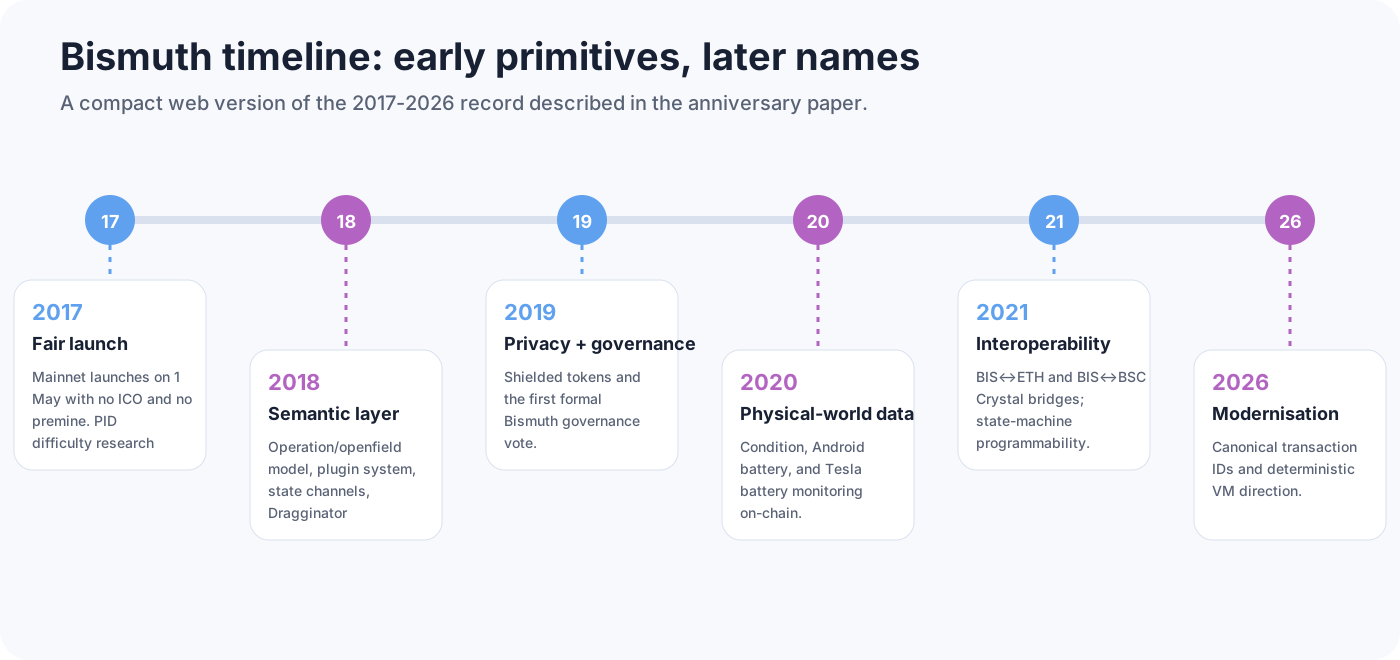
| Year | Bismuth milestone | Later industry framing |
|---|---|---|
| 2017 | Mainnet launches on 1 May with no ICO and no premine. Proof-of-work difficulty is treated as a control-systems problem. | Fair launch, research-led consensus design |
| 2018 | Semantic Interpretation, plugin architecture, state-channel concepts, event sourcing, and Dragginator collectibles appear in the public record. | Modular execution, off-chain indexers, NFTs, app-specific protocols |
| 2019 | Shielded tokens and formal governance vote BGV-01. | Confidential assets, DAO-style governance |
| 2020 | Condition monitoring, Android battery monitoring, and Tesla battery monitoring publish physical-world data to the chain. | DePIN-like telemetry and machine data |
| 2021 | BIS↔ETH and BIS↔BSC Crystal bridges ship; state-machine programmability is articulated. | Multi-chain interoperability, explicit app-state machines |
| 2026 | Modernization direction includes canonical transaction identity and deterministic execution. | Canonical execution and value-bearing interpretation |
The architectural insight: data is not the same as meaning
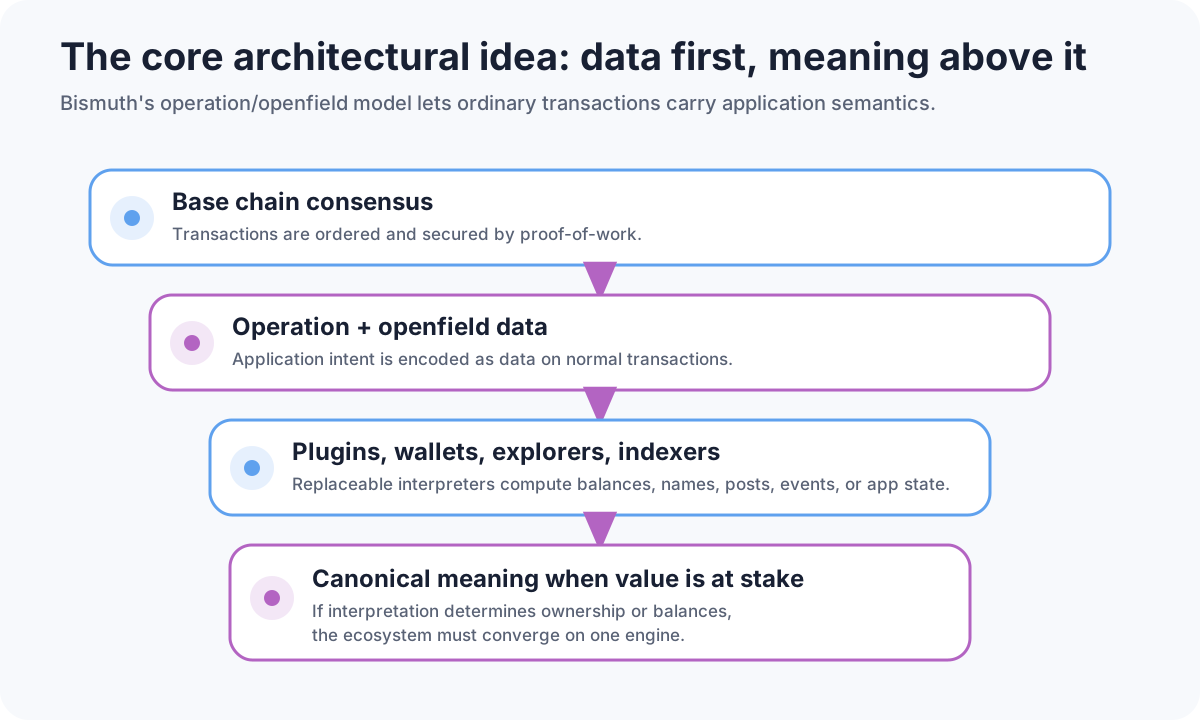
The most important idea in Bismuth’s early design is simple but deep:
A blockchain can agree on data without forcing every possible interpretation of that data into the base protocol.
Bismuth’s transaction model made this practical. Each transaction can include:
- an operation field, such as
token:issue,token:transfer, or another application-defined action; - an openfield, an arbitrary data field that carries the payload to be interpreted.
That means the base chain can secure and order the data, while wallets, explorers, plugins, indexers, or other software can interpret that data into higher-level meaning.
This is the same general shape that later appeared in several mainstream systems:
- Inscriptions: put data on-chain, interpret it off-chain.
- BRC-20: interpret inscription data into token balances.
- Rollups and modular chains: separate data availability, execution, and settlement.
- Indexers and subgraphs: transform raw chain events into application state.
Bismuth’s 2018 Semantic Interpretation paper went one step further. It recognized that plural interpretation is useful only up to a point. When interpretation carries value, such as ownership, balances, or executable state, the ecosystem must converge on a canonical engine.
That caveat is now familiar from inscription ecosystems: if different indexers disagree, users do not have one reliable reality. Bismuth identified the shape of that problem years earlier.
Bismuth before the buzzwords
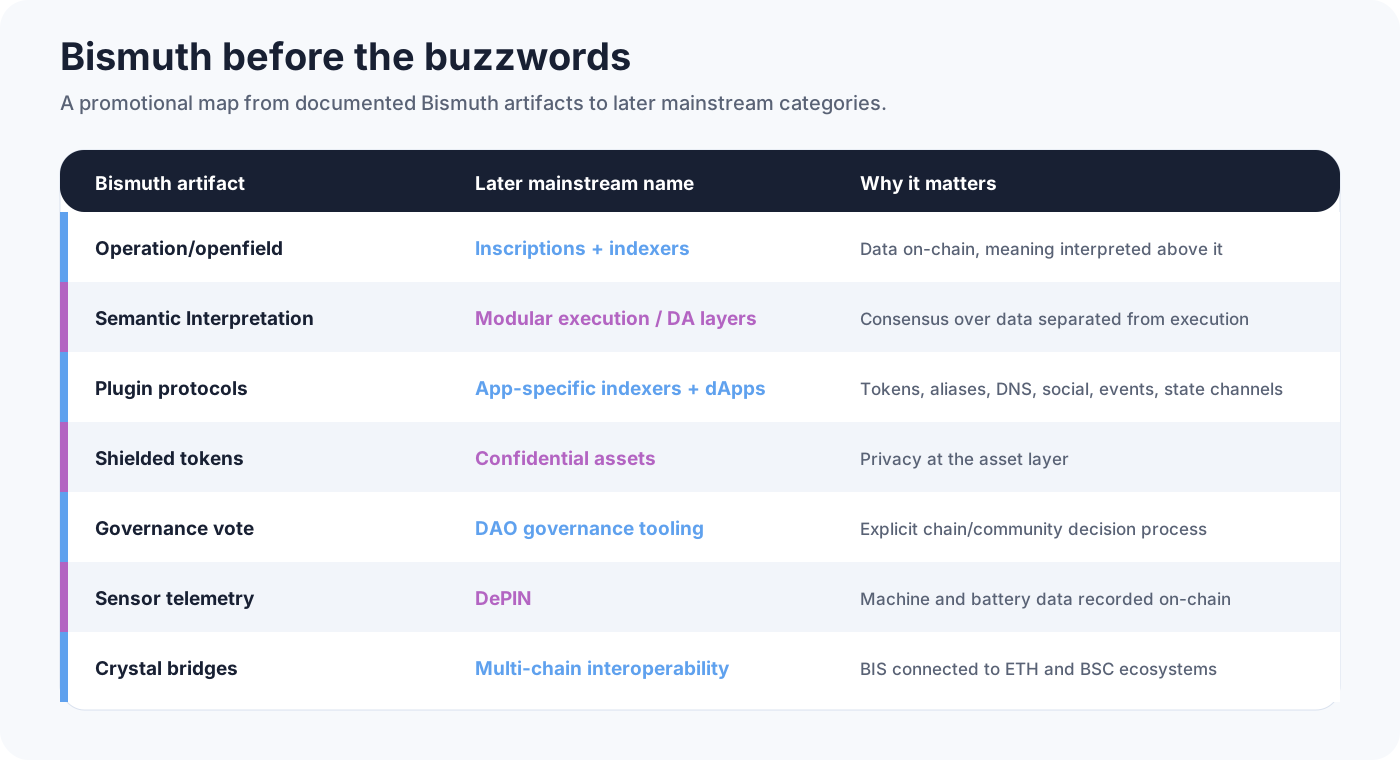
| Bismuth artifact | Date in Bismuth record | Later mainstream category | Why it matters |
|---|---|---|---|
operation + openfield transaction data | 2017-2018 | Inscriptions, indexer protocols | The chain secures data; external software interprets meaning. |
| Semantic Interpretation | July 2018 | Modular blockchains, data-availability layers | Consensus over data is separated from execution and interpretation. |
| Plugin system | July 2018 onward | App-specific middleware and protocol modules | Wallets, explorers, monitoring, token logic, and custom features attach without core changes. |
| Hack-with-BIS protocol corpus | 2018 onward | Developer protocol ecosystems | Tokens, aliases, DNS, social, event sourcing, secure storage, state channels, and dApp examples were documented as application protocols. |
| Dragginator collectibles | 2018 | NFTs / digital collectibles | User-created non-fungible collectibles appeared on a non-Ethereum chain early in the NFT timeline. |
| Shielded tokens | 2019 | Confidential assets | Privacy was explored as an asset-layer property, not only as a whole-chain feature. |
| BGV-01 governance vote | 2019 | DAO governance | Protocol decisions were made explicit and accountable through formal voting. |
| On-chain battery and condition monitoring | 2020 | DePIN | Real-world machine and battery telemetry was recorded and interpreted from the chain. |
| BIS↔ETH and BIS↔BSC Crystal bridges | 2021 | Cross-chain interoperability | Bismuth connected to Ethereum and BNB Smart Chain during the early multi-chain bridge era. |
| Canonical transaction IDs and deterministic VM direction | 2026 | Canonical execution | Value-bearing interpretation moves back toward one agreed engine where necessary. |
1. A fair-launched chain with unusual technical freedom
Bismuth launched without an ICO or premine. That matters because the project’s technical record is easier to evaluate without assuming that early design claims were created as a token-sale narrative.
The chain was also written from scratch in Python. Contemporary accounts described it as the first Python blockchain; the safer historical phrasing is that Bismuth was among the earliest, and widely described as the first, from-scratch Python blockchain projects.
That codebase gave the project freedom to experiment. Instead of copying Bitcoin’s UTXO structure or Ethereum’s account-plus-nonce model, Bismuth chose an account-based design with signature-derived transaction identifiers and flexible application data fields.
The design was not only experimental. Bismuth’s difficulty adjustment was treated as a formal feedback-control problem. The project’s proof-of-work difficulty controller and tail-removal validation changes were analyzed in peer-reviewed control-systems publications, grounding the project’s “early architecture” story in research rather than just retrospective marketing.
2. Plugins: the application layer above consensus
Bismuth’s plugin system turned the semantic idea into an engineering pattern.
Instead of adding every feature directly to the base protocol, plugins could attach behavior around wallets, explorers, token logic, monitoring, event parsing, and application-specific protocols. This made Bismuth feel less like a monolithic smart-contract chain and more like a programmable data layer with replaceable interpretation engines.
The Hack-with-BIS corpus showed how far this could go. It documented application protocols for:
- tokens;
- aliases and naming;
- Bisnet-DNS;
- social attestations;
- event sourcing;
- off-chain secure storage;
- state channels;
- collectible creatures through Dragginator;
- dApp patterns compared with Solidity-style design.
The important point is not that Bismuth invented every primitive. The point is that Bismuth assembled and documented them early using a consistent architecture: ordinary transactions become application state when interpreted by agreed software.
3. The indexer-consensus problem, named before it became fashionable
The inscription era made one issue unavoidable: putting data on-chain is easy, but agreeing on what the data means is hard.
For example, an inscription-style token can store transfer data on-chain. But if the base chain does not enforce the token rules, then balances depend on off-chain software. When multiple indexers disagree, the ecosystem has to decide which interpretation counts.
Bismuth’s 2018 semantic model anticipated this tension. It allowed plural interpretation where that was useful, but also recognized that value-bearing interpretation must eventually become canonical.
That is why Bismuth’s modern direction is significant. Moving toward canonical transaction IDs and deterministic virtual-machine execution is not a rejection of the earlier semantic model. It is the completion of it: use flexible interpretation where possible, but fold interpretation into consensus where ownership, balances, and irreversible state require one agreed result.
4. Privacy, governance, DePIN, and bridges
Bismuth’s decade-long record is not limited to one architectural idea. The same pattern repeated across several categories.
Confidential assets
Bismuth introduced shielded tokens in 2019. This framed privacy as something that can exist at the asset layer, rather than only as a whole-chain property. That distinction is increasingly relevant as chains look for selective privacy without turning every transaction into a fully private base-layer transfer.
Governance
Bismuth’s 2019 governance shift and BGV-01 vote made protocol decision-making more explicit. That fits the lesson of Semantic Interpretation: if the true point of failure is social consensus around software, governance should be visible, accountable, and documented.
Physical-world data
In 2020, Bismuth published examples of condition monitoring, Android battery monitoring, and Tesla battery monitoring. These were practical demonstrations of real-world machine and battery telemetry written to and interpreted from a general-purpose chain.
The term DePIN was coined later, but the structure is recognizable: physical-world infrastructure or devices create data that becomes verifiable, queryable, and economically meaningful through a decentralized network.
Bridges and programmability
In 2021, Bismuth shipped BIS↔ETH and BIS↔BSC Crystal bridge connectors. The timing matters: this was the same period in which the broader market moved into the multi-chain bridge era. In parallel, Bismuth continued to explore explicit state-machine programmability as a way to build applications without simply copying the EVM model.
5. The main lesson: interpretation must become canonical when value depends on it
The most important takeaway from Bismuth’s first decade is not “Bismuth was first at everything.” That would be the wrong claim.
The stronger and more useful claim is this:
Bismuth repeatedly occupied architectural design space before the market had popular names for it.
Its history shows that durable ideas can appear early in small, unfashionable projects:
- data separated from meaning;
- plugin-based interpretation;
- application protocols above the base chain;
- event-sourced state;
- asset-level privacy;
- formal governance;
- physical-world telemetry;
- bridges and explicit state machines.
But the same history also exposes the hard limit of plural interpretation. If interpretation determines ownership, balances, or executable state, it cannot remain merely optional. It must become canonical, or the network fragments into incompatible realities.
That is why the next stage of Bismuth is not just another feature cycle. It is an architectural continuation: from flexible semantic interpretation toward deterministic canonical execution where value requires it.
Why this matters now
Bismuth’s story is useful for builders because it cuts through narrative cycles.
The industry often treats ideas as new when they become marketable. Bismuth shows another pattern: useful primitives can be built, tested, and documented long before they are named by the market.
For developers, Bismuth is a case study in lightweight protocol extensibility.
For researchers, it is a reminder that proof-of-work systems can be studied as feedback-control systems, not only as economic games.
For blockchain historians, it is evidence that fair-launched projects without large promotional budgets may contribute more to the technical record than their public visibility suggests.
For the Bismuth community, it is a clear message to promote:
Bismuth was early, documented, research-grounded, and still building.
Shareable short version
Bismuth is a fair-launched, from-scratch blockchain that began in 2017 with no ICO and no premine. Over its first decade, it documented and shipped ideas the wider crypto industry later rediscovered under names like modular blockchains, inscriptions, indexers, confidential assets, DAO governance, DePIN, and cross-chain bridges.
Its central lesson remains highly relevant: blockchains can agree on data while letting interpretation happen above the base layer, but when interpretation carries value, the network must converge on a canonical engine.
Built first. Named later.
Source
This article is adapted from:
Bismuth Foundation. “10 Years of Bismuth: Architectural anticipation in a fair-launched blockchain, 2017-2026.” June 2026.
PDF: https://bismuth.cz/10-years-of-bismuth.pdf